Welcome Home: Apple Just Reinvented the Smart Home
Apple has unveiled HomeView, a new HomePod mini, a more powerful Apple TV 4K and an entire collection of smart home accessories. But behind the hardware announcements lies something far more interesting: a serious attempt to make the connected home feel like one complete Apple experience.
For years, Apple has been quietly working its way into our homes. First came Apple TV, followed by HomeKit, the Home app, HomePod and, more recently, the gradual adoption of Matter and Thread. Each development brought another piece of the connected home puzzle into Apple's ecosystem, but despite all the technology, it never quite felt as though the company had assembled the finished picture. We could control our lights from an iPhone, ask Siri to adjust the heating, play music across different rooms and check our security cameras while away from home, yet the whole experience still felt like a collection of individual features rather than something truly joined together.
That may be about to change.
At today's Welcome Home event, Apple unveiled what is arguably its most ambitious move into the smart home market since HomeKit first appeared. Four major announcements, including an entirely new product category, an updated HomePod mini, a fourth-generation Apple TV 4K and a collection of purpose-designed smart home accessories, suggest the company is no longer content simply to participate in the connected home. Apple wants to define how we interact with it.
The significance of today's announcements isn't necessarily found in any single product. Smart displays already exist, as do connected doorbells, intelligent thermostats, wireless speakers and voice-controlled televisions. Competitors have been developing these technologies for years, with varying degrees of success. What makes Apple's approach interesting is the way it intends to bring everything together, combining the hardware, software, artificial intelligence and personal information already associated with the devices millions of us carry around every day.
I've always found the smart home an interesting contradiction. The promise is that technology will simplify our lives, yet achieving that simplicity frequently involves installing several applications, creating additional accounts, configuring automations and occasionally standing in a room repeatedly asking a voice assistant to turn on a light that would have responded immediately to a perfectly ordinary switch. When the technology works, it's wonderful. When it doesn't, it can make even the simplest household task unnecessarily frustrating.
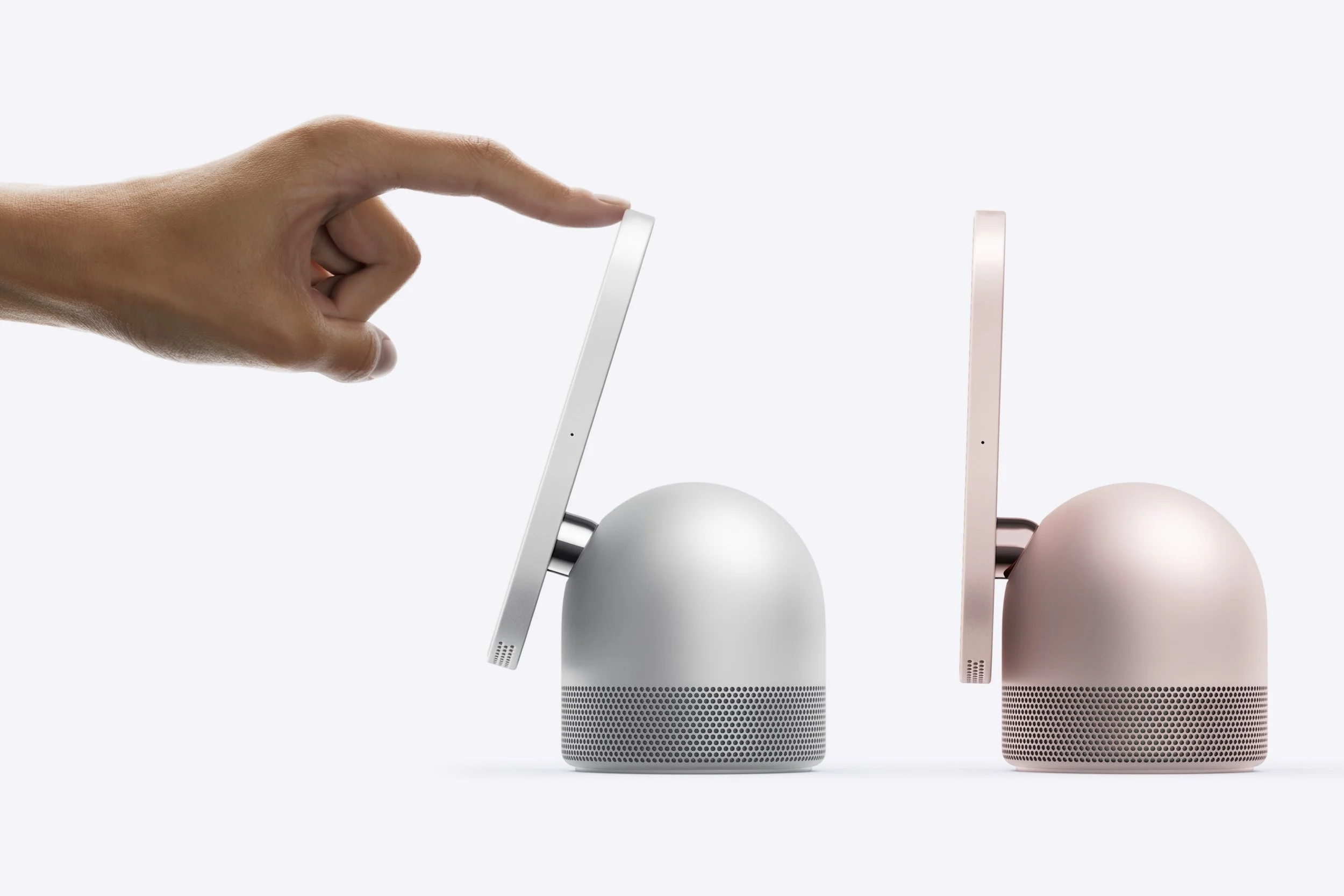
Apple's answer to this problem is HomeView, and it's easily the most interesting product announced today.
At first glance, HomeView looks rather like a small iPad attached to a HomePod, but that description doesn't really do justice to what Apple is trying to achieve. The device features a 7-inch Liquid Retina display mounted above a rounded speaker base, connected by a stainless steel hinge that allows the screen to tilt into a comfortable viewing position. Finished in aluminium and available in silver, starlight, rose pink and space grey, it's very much the sort of understated design you'd expect from Apple. There's also a dedicated wall-mounted version, intended for places such as hallways and entrances where a permanently installed control panel might be more appropriate than something sitting on a worktop.
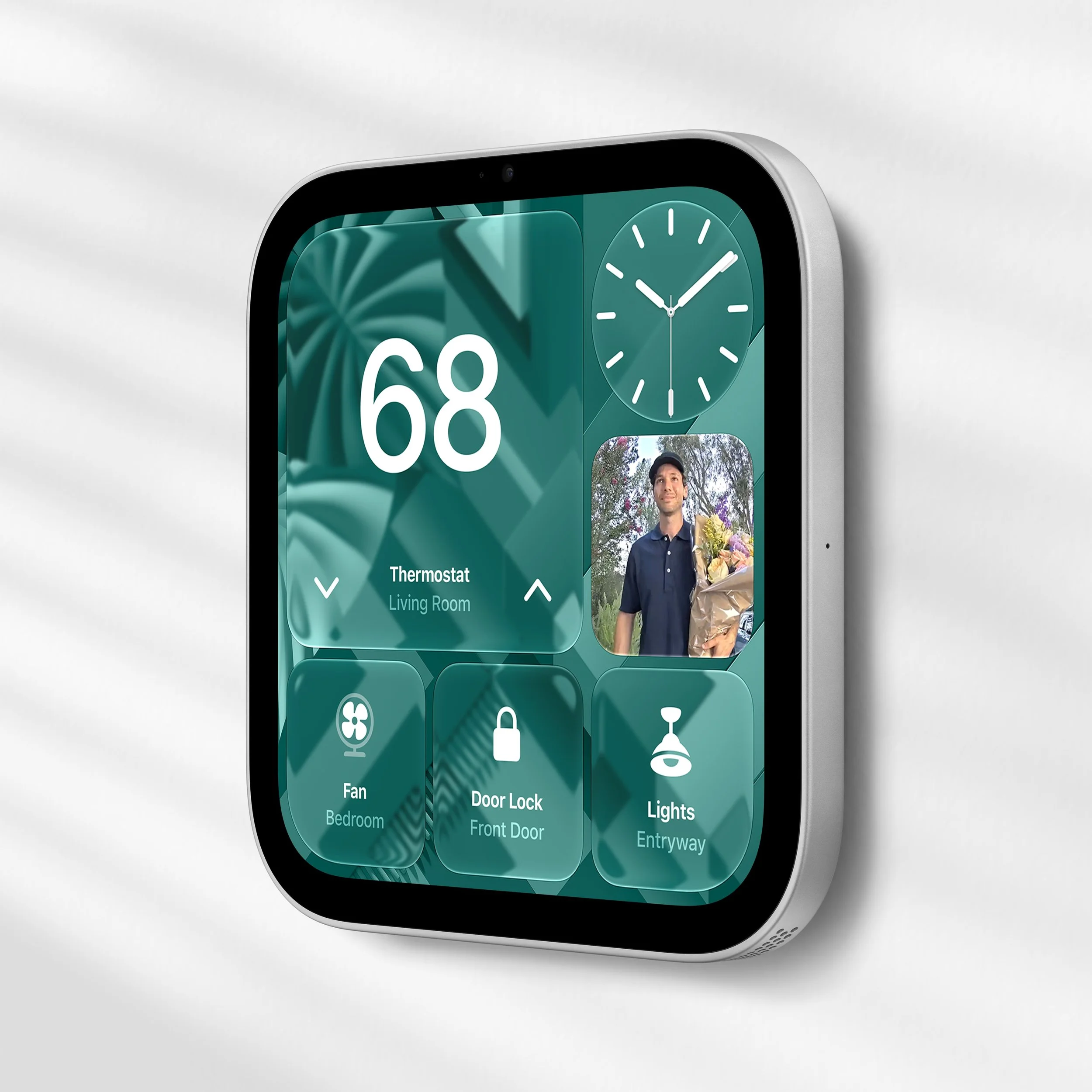
What interests me isn't simply how HomeView looks, but how Apple expects people to use it. Unlike an iPad, which generally demands your attention and some form of direct interaction, HomeView is designed to exist in the background of everyday life, presenting information when it's useful and becoming more interactive when you approach. Its display adjusts automatically to changing lighting conditions, while the interface itself changes according to how far away you're standing. From across the kitchen it might show the time, weather and upcoming appointments; move closer and more detailed information and controls become available.
It's a small but rather clever distinction. A device sitting in the middle of a busy household needs to be useful without constantly demanding that somebody picks it up, unlocks it and navigates through applications. Apple appears to understand that the home requires a different kind of interface from the one we've become accustomed to carrying in our pockets.
HomeView can recognise up to six members of a household using facial recognition, automatically presenting each person with their own personalised screen and information. Your calendar, reminders and messages can appear when you approach, while another family member sees their own content instead. Shared photographs, music and household controls remain accessible to everyone, but personal information is protected through a combination of facial recognition and security checks involving a paired iPhone or iPad.
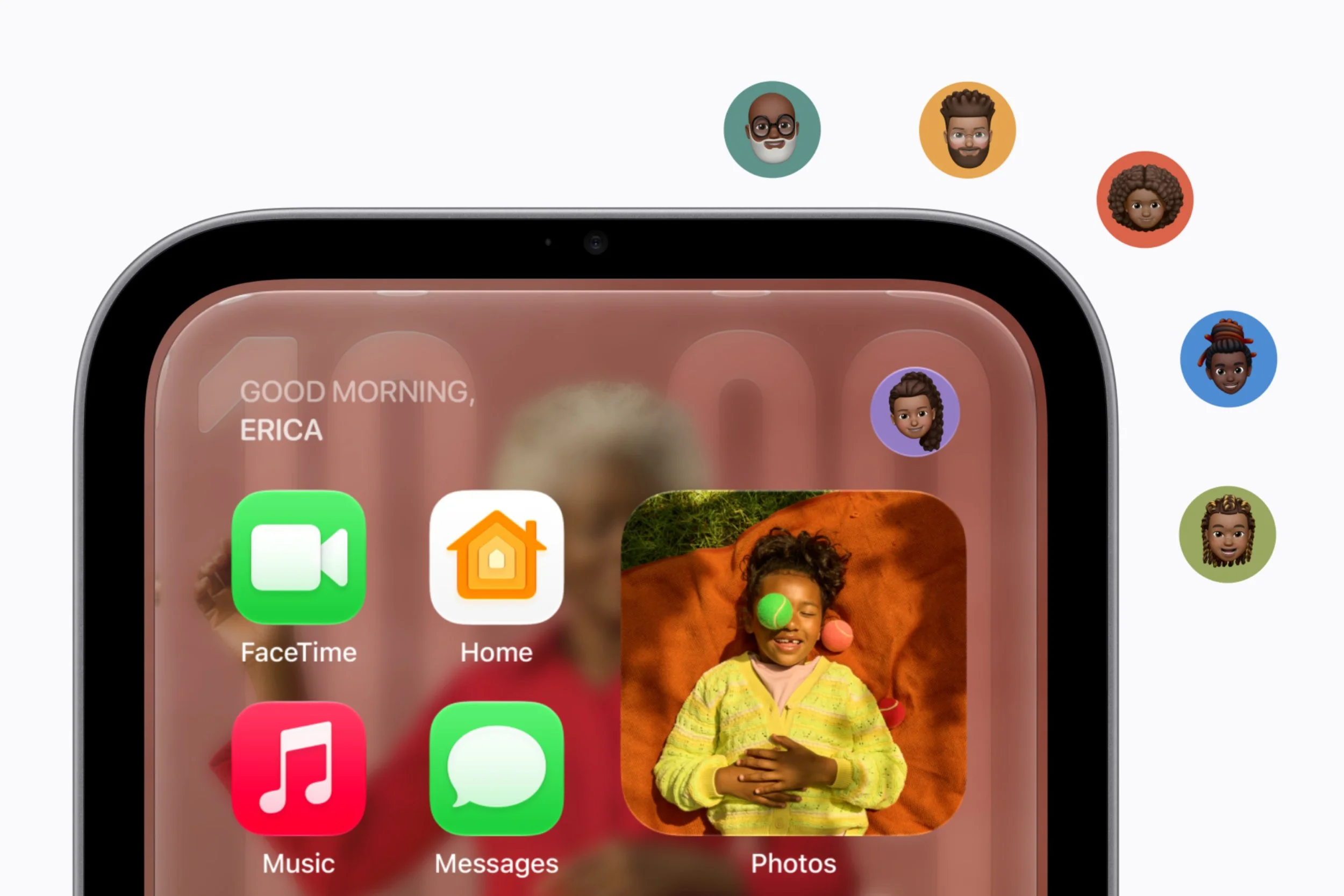
That ability to make a communal device feel personal is potentially one of HomeView's greatest strengths. A household isn't a single user, and the assumption that everyone wants to see the same information has always been one of the more awkward aspects of shared smart displays. If Apple can make switching between people feel natural and reliable, HomeView could become genuinely useful in places where an ordinary tablet never quite makes sense.
The possibilities extend well beyond checking appointments or switching on lights. Apple has included FaceTime with Center Stage, Messages, Find My, Intercom and support for entertainment services including Apple Music, Podcasts and Apple TV. Its integrated speaker system combines drivers within the display with a downward-firing woofer and passive radiators in the base, with computational audio adjusting performance automatically. In the kitchen, it can turn recipes found online into step-by-step instructions, help manage ingredients and set timers without needing to touch the screen. Elsewhere, it can operate as a digital photo frame, displaying family photographs or Apple's more playful animated faces, including Snoopy.
I rather like that Apple hasn't forgotten the personality of the product. Not everything in our homes needs to look like a corporate control panel, and a display that occasionally shows Snoopy reacting to the weather is considerably more appealing than another collection of switches and status indicators.
But the biggest difference between HomeView and the smart displays we've seen before is what sits behind the screen. Apple has introduced Siri AI, a substantially reworked version of its voice assistant powered by the next generation of Apple Intelligence, and this could ultimately prove to be the most consequential part of the entire Welcome Home announcement.
Siri has had a rather peculiar existence over the past decade. It arrived early, helped introduce the idea of speaking naturally to our devices and became an integral part of Apple's operating systems, yet its abilities increasingly struggled to match our expectations. Asking Siri to set a timer or play a particular song generally worked well enough, but anything requiring more complex understanding could become an exercise in finding the exact phrasing it expected.
The arrival of conversational artificial intelligence has made those limitations much harder to ignore. We've become accustomed to systems that understand follow-up questions, maintain context and interpret requests expressed in ordinary language. Apple now wants Siri to provide that same flexibility while retaining the privacy protections it has made central to its products.
On HomeView, Siri AI promises broader knowledge, an understanding of information displayed on screen and the ability to hold more natural conversations. When paired with a compatible Apple Intelligence-enabled iPhone or iPad, it can also access relevant personal context from supported applications. Rather than issuing several individual commands, users should be able to ask Siri to find a recipe received in an email, identify the ingredients they need and add them to a shopping list, or locate music that somebody recommended in a message.
The important word here is should. Apple has demonstrated the capabilities it intends to deliver, but until people have lived with Siri AI in ordinary homes, surrounded by television noise, overlapping conversations and all the unpredictability of family life, we won't know how well those promises translate into everyday use.
Nevertheless, the direction is exactly where Siri needs to go. An assistant that understands the context of a request is far more valuable than one that simply recognises a fixed collection of instructions. And placing that assistant in a shared household device rather than limiting it to an individual's phone could change how frequently people interact with it.
Apple has also given considerable thought to how those conversations move between devices. A discussion started on HomeView can continue through the new Siri app on an iPhone, iPad, Mac, Apple Watch or Vision Pro, with conversation history synchronised privately through iCloud. It's another example of Apple's broader philosophy: the device you're using should be less important than the task you're trying to complete.
Of course, Apple is well aware that placing microphones, cameras and personal information in the middle of people's homes raises serious privacy questions. HomeView uses the A18 chip and protected processing environments called Secure Exclaves to isolate sensitive camera and microphone data. Personal content is only revealed when the appropriate household member is recognised and their paired device meets Apple's security requirements, while Siri requests can be processed locally or through Private Cloud Compute.
These are reassuring measures, although their effectiveness will ultimately need to be judged through independent testing and continued scrutiny. There's a substantial difference between protecting personal information stored on a phone and managing a device potentially accessible to an entire household, including visitors. Apple clearly understands that trust will be essential if it expects people to place HomeView in their kitchens, bedrooms and living rooms.
And that's where the rest of today's announcements begin to fit together.
While HomeView provides the central interface, Apple has refreshed the hardware that allows its ecosystem to extend throughout the house. The second-generation HomePod mini retains the familiar compact spherical design but introduces the S10 chip, improved computational audio and support for the new Siri AI experience. It arrives in five colours — pink, green, blue, white and midnight — and continues to offer the flexibility of individual speakers, stereo pairs and multiroom playback.
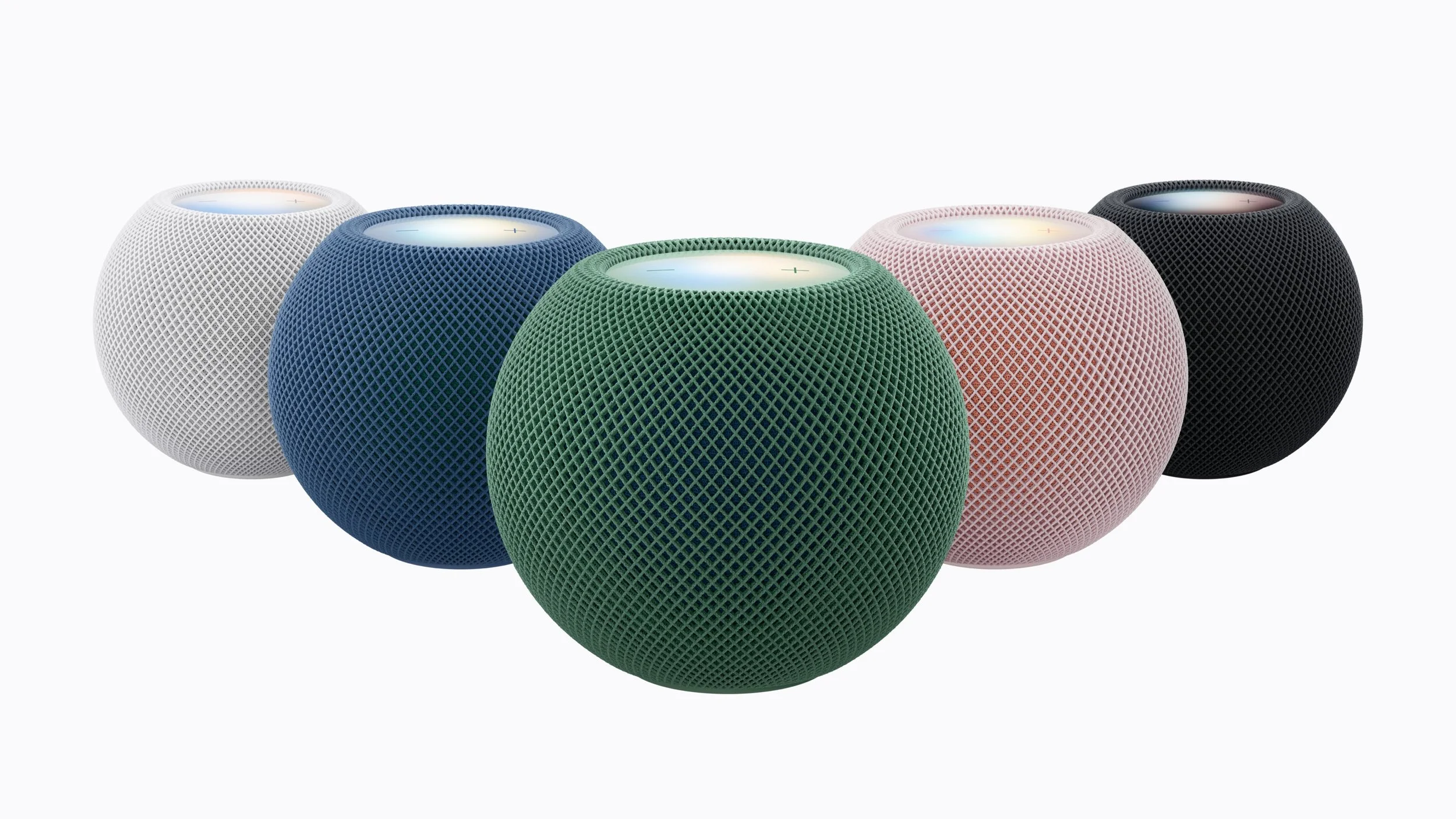
There is also a rather delightful new feature called Sound Glow. Instead of limiting the illuminated surface to Siri interactions, the top of the HomePod mini can now respond to music, pulsing with bass and treble while displaying colours inspired by the artwork of whatever you're listening to. Environmental soundscapes can produce their own visual effects, turning the speaker into something a little more atmospheric.
No, it's not a feature anybody desperately needs, but technology doesn't always have to justify its existence through productivity improvements. Sometimes the little touches are what make a product enjoyable to live with. Apple has historically been very good at those details, and Sound Glow sounds like exactly the sort of flourish that will make the new HomePod mini feel more engaging than its predecessor.
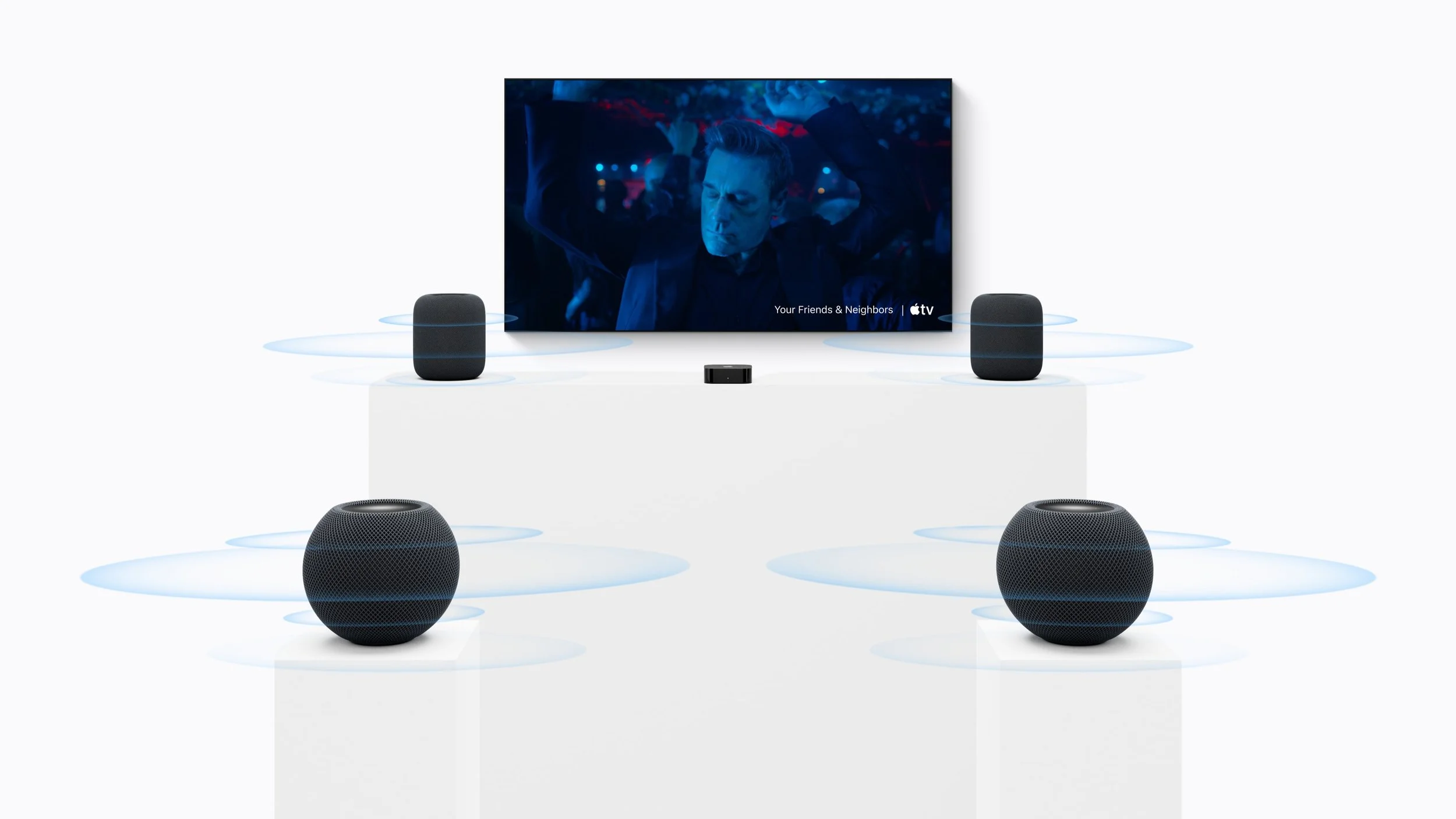
The more substantial improvement is its expanded relationship with Apple TV. For the first time, Apple is supporting a four-speaker surround sound configuration using compatible HomePod speakers and the new Apple TV 4K. Two matching speakers can sit at the front of the room, with another matching pair behind the listening position, while the system automatically calculates speaker positioning and calibrates audio timing and levels.
That's a genuinely interesting proposition for anyone who wants a more immersive home cinema experience without introducing a traditional AV receiver and complicated speaker wiring. Dedicated surround sound systems still have their advantages, of course, and I wouldn't expect four compact HomePods to suddenly replace a serious home cinema installation. But there's an enormous audience for something that sounds good, looks discreet and works without requiring an evening spent reading instruction manuals.
The HomePod mini 2 can also operate as a speaker for compatible Macs, which caught my attention. A tidy desktop setup has always appealed to me, and the prospect of using a matching HomePod stereo pair with a Mac is rather attractive, particularly if the wireless connection proves reliable enough for everyday work, video calls and entertainment.

At £149 in the UK, with availability beginning on 30 October, the HomePod mini 2 isn't exactly an impulse purchase, particularly if you're considering several speakers around the house. There's also an important qualification: Siri AI won't be available on the new HomePod mini immediately. Apple says the feature will arrive through a future software update, with certain personal-context capabilities requiring a compatible iPhone or iPad. Anyone buying specifically for the new assistant needs to bear that in mind.
The fourth-generation Apple TV 4K, meanwhile, is developing into something far more substantial than a streaming box.
I've always thought Apple TV was one of the company's more underrated products. It doesn't attract the excitement of a new iPhone or Mac, but it offers a consistent interface, a familiar ecosystem and an experience that generally feels considerably more polished than many of the operating systems built directly into televisions. Today's update strengthens that position with Apple's A19 chip, providing significantly more processing and graphics performance than the previous generation, alongside dedicated AV1 decoding for more efficient streaming.
More interestingly, Apple TV is becoming another major home for Siri AI. The new model includes three far-field microphones, allowing people to speak directly to the television without reaching for the remote. Apple is introducing more conversational content discovery, meaning viewers will be able to ask about programmes, explore recommendations and find films without necessarily remembering their exact titles.
That sounds particularly useful given how absurdly complicated choosing something to watch has become. Between the various streaming subscriptions, enormous content libraries and competing recommendation systems, it's entirely possible to spend longer deciding what to watch than actually watching anything. If Siri can understand a request expressed in normal conversation and narrow down the options intelligently, it could become one of the most useful features on the platform.
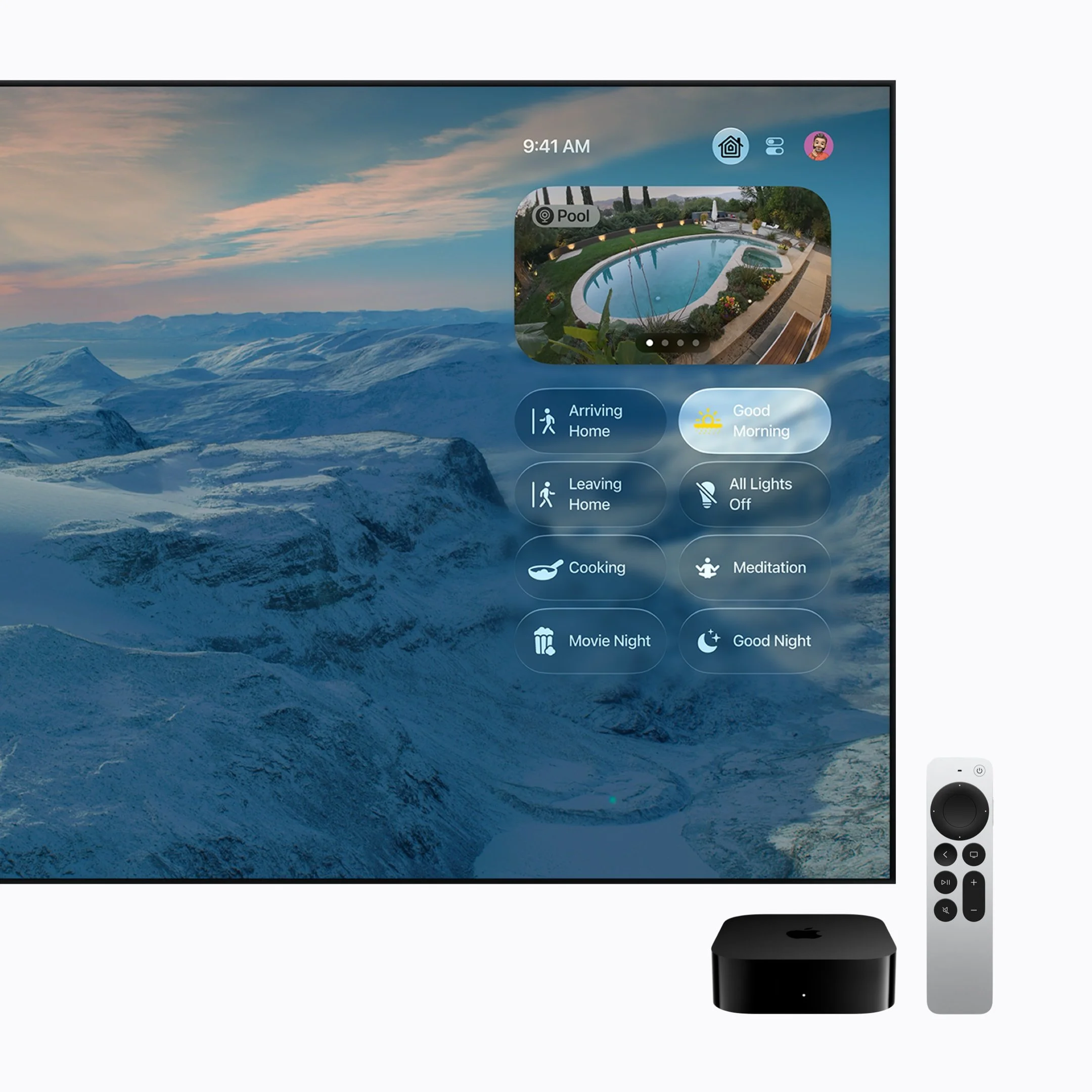
Apple has also improved the way its television experience connects with the rest of the home. Security camera notifications, video doorbell activity and smart lock controls become part of the living room experience, while HomeKit Secure Video can provide intelligent descriptions of recorded events. The television is no longer simply where you watch programmes; it becomes another point of access to the connected home.
Even the Siri Remote has received some welcome attention, with Precision Finding and the ability to play a sound when misplaced. Having spent more time than I care to admit searching for remote controls that have somehow disappeared between sofa cushions, I suspect that particular feature will receive more appreciation than some of the impressive processing statistics.
The new Apple TV 4K is available to pre-order now, with UK availability beginning on 13 November at £299. That's a substantial price for something many people will initially compare with inexpensive streaming sticks, but Apple is clearly positioning the hardware as an entertainment system, gaming platform, intelligent assistant and home automation hub rather than simply another way to access Netflix.
It's also worth mentioning that Siri AI is available in beta for second-generation and later Apple TV 4K models, subject to the relevant compatibility requirements. Existing users aren't necessarily being left behind simply because new hardware has arrived.

However, even with HomeView, HomePod mini and Apple TV working together, Apple's ambitions would remain incomplete without the accessories that make a connected home useful in the first place. This is where the fourth announcement, Apple Home Collection, becomes particularly important.
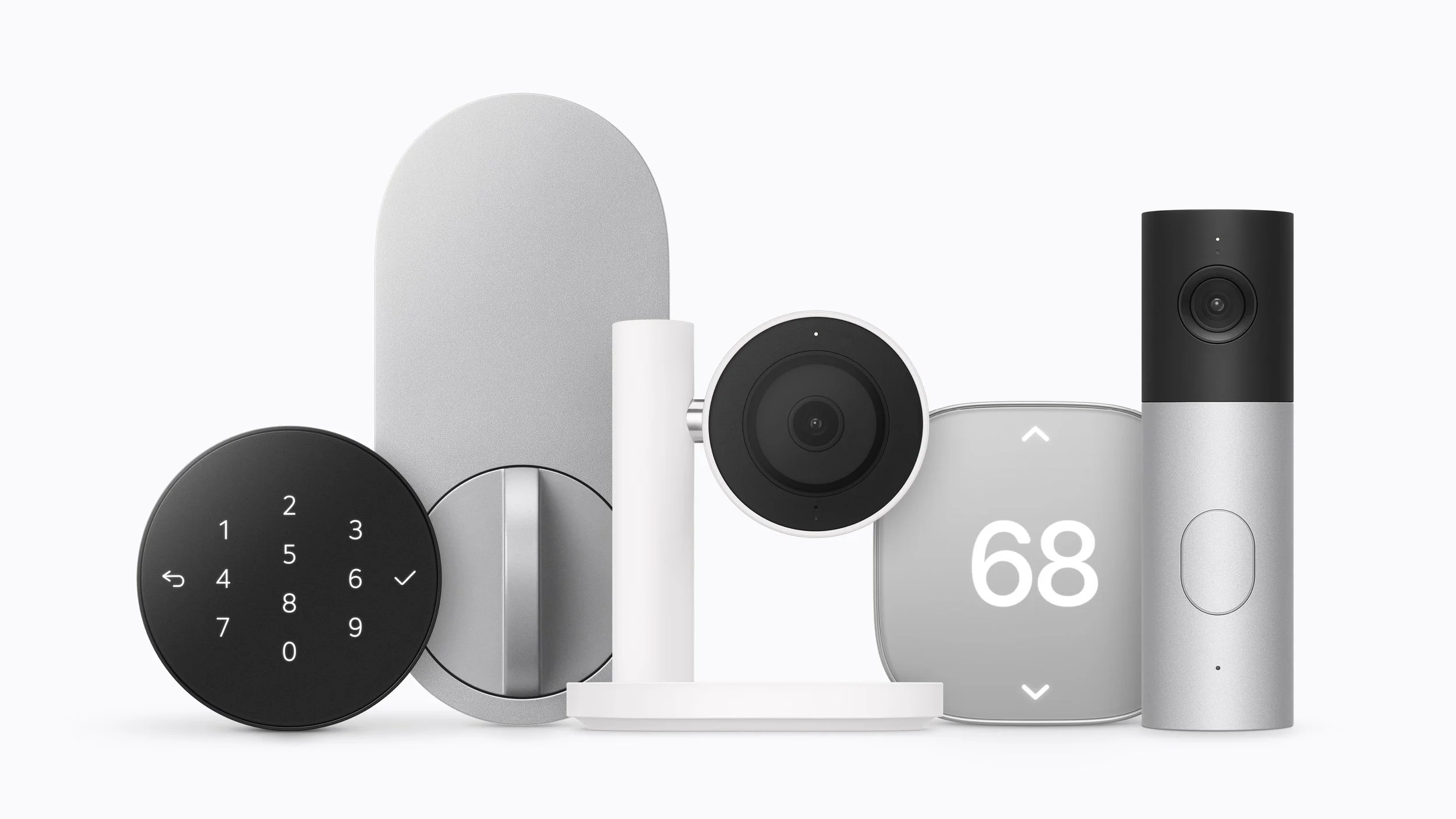
Working with LG Electronics and Schneider Electric, Apple has introduced a coordinated family of smart home cameras, a video doorbell, a connected lock, thermostats and environmental sensors. These aren't simply generic products with an Apple compatibility badge attached. They're accessories developed around a common experience, with straightforward setup through the Home app and tighter integration with Apple's wider ecosystem.
For years, buying smart home equipment has often meant accepting whatever application, account system and subscription model a particular manufacturer decides to use. You might have one application for the heating, another for the cameras, a third for the lighting and something entirely different for the front door. Even when everything technically supports HomeKit or Matter, the experience can feel fragmented.
Apple Home Collection attempts to remove much of that friction by bringing ordinary setup and management into the Home app. The result should be a more consistent approach regardless of whether you're checking a security camera, adjusting the heating or managing access to the house.
LG's camera range is particularly interesting. The collection includes an indoor camera, outdoor camera, video doorbell and floodlight camera, with video capture up to 2.5K on supported models. The doorbell uses two cameras to provide separate views of visitors and packages, while the outdoor products offer features such as colour night vision and intelligent activity detection.
The indoor camera has a privacy feature I particularly appreciate: it can physically tilt down when somebody returns home, preventing the camera from continuing to monitor the room. There's something reassuring about a visible, mechanical response rather than simply relying on a small status indicator or the promise that software has stopped recording.
With a compatible iCloud+ subscription, Apple's intelligence features can also recognise categories of activity and produce descriptions of recorded events. Rather than manually searching through camera footage, users should be able to identify relevant moments through more natural requests. This feels like a sensible use of artificial intelligence, particularly if it reduces the number of meaningless motion alerts that have become such a familiar part of owning security cameras.
The new smart lock introduces another interesting possibility through Ultra Wideband proximity detection. Using a compatible iPhone or Apple Watch, the system can recognise an authorised person approaching the door and unlock automatically, while alternative methods including a PIN and physical key provide backup access. It's the kind of convenience that sounds almost trivial until you imagine arriving home with your hands full of shopping.
Naturally, a lock is also something that needs to be extraordinarily reliable. Nobody wants to discover that their front door has become dependent on a temperamental wireless connection or a confused automation. Apple and LG say important local functionality remains available without an internet connection, which is encouraging, but real-world reliability and UK door compatibility will be crucial considerations.
The thermostats and environmental sensors complete the picture by giving Apple more information about household conditions and allowing compatible heating systems to respond to occupancy and daily routines. Instead of constantly adjusting a schedule, the ambition is for the home to recognise when people are present, when they've left and when the temperature should change.
There's also a wider energy-efficiency argument here. Heating an empty house unnecessarily makes little sense, particularly with the cost of energy in the UK, although some of Apple's advanced utility-related features will initially be restricted to other markets. Compatibility with existing British heating systems will also determine how useful these products become.
The Home Collection cameras are expected to begin arriving in December, with UK pricing starting at £179.95 for the LG Indoor Cam, £229.95 for the Video Doorbell, £279.95 for the Outdoor Cam and £349.95 for the Floodlight Cam. Other accessories will follow according to their respective launch schedules.
None of this is particularly cheap, and that's perhaps the biggest challenge facing Apple's vision.
A HomeView in the kitchen, several HomePod speakers, a new Apple TV, security cameras, a video doorbell, smart locks and heating controls could quickly become a significant investment. Apple has rarely competed primarily on price, preferring to emphasise design, integration, longevity and the overall experience, but building an entire connected home is rather different from choosing a new phone. It's also important that people who have already invested in compatible devices aren't expected to replace everything simply to enjoy the improvements.
Fortunately, HomeView continues to support Works with Apple Home and Matter accessories, and the broader strategy builds on the interoperability standards Apple has been supporting for several years. That doesn't mean every existing device will suddenly gain the advanced features of the new Home Collection, but it does mean Apple's vision isn't exclusively dependent on purchasing its newly coordinated accessories.
And this brings me back to what I think today's event is really about.
Consider an ordinary day in a household built around this new ecosystem. You walk into the kitchen and HomeView recognises you, displaying your calendar and reminders while Siri provides the information you need for the morning. Music plays quietly from the speakers while the heating adjusts to the household routine. As everyone leaves, the appropriate automations activate, cameras begin monitoring and the front door secures itself.
Later, a delivery arrives and the doorbell provides a notification explaining what's happened. When you return home, the system recognises your approach, prepares the heating and allows you inside. In the evening, Apple TV helps you find something to watch, the HomePod speakers provide surround sound and the same connected devices that managed the house throughout the day remain available without requiring you to think about which application controls what.
Of course, none of this is a guarantee that every feature will work perfectly, nor is the underlying concept particularly new. Amazon, Google and specialist smart home manufacturers have been pursuing similar ambitions for years. The difference is that Apple now has a coordinated product range, an established ecosystem of personal devices, its own silicon, a renewed artificial intelligence strategy and an opportunity to make the whole experience feel consistent.
I think that's what has been missing from the smart home for so long. Not another gadget, another screen or another complicated automation, but a sense that everything belongs together.
There are still plenty of questions. Siri AI needs to demonstrate that it can deliver reliable, genuinely useful conversations rather than simply producing impressive demonstrations. HomeView's facial recognition must be both quick and trustworthy, especially when dealing with personal messages and calendars in shared spaces. The smart home accessories need to function predictably when connectivity becomes unreliable, and Apple's privacy commitments will need to stand up to scrutiny as these systems become more deeply embedded in everyday domestic life.
I'd also like to see how gracefully Apple accommodates households that don't use its products exclusively. While Matter improves compatibility, the more advanced personal experiences clearly depend on compatible Apple hardware. That's understandable, but the home is a shared environment, and not everyone living under the same roof necessarily wants to use the same ecosystem.
Nevertheless, I find today's announcements genuinely exciting, particularly because they suggest Apple is finally treating the connected home as a complete platform rather than a collection of supporting accessories.
HomeView is undoubtedly the product I'm most curious to see in person. It feels like the missing centrepiece of Apple's home strategy, giving the ecosystem a dedicated interface that neither the iPhone nor the original HomePod could quite provide. The new HomePod mini brings improved audio possibilities and a touch more personality, Apple TV continues evolving beyond entertainment, and Home Collection addresses the practical hardware that makes home automation worthwhile.
But perhaps the biggest opportunity lies with Siri AI. If Apple can finally deliver the conversational understanding and personal awareness it's promising, the entire ecosystem becomes more useful. The difference between issuing commands to a series of connected devices and interacting naturally with an intelligent home is enormous.
Apple has spent decades refining the relationship between people and technology. The Mac made personal computing approachable, the iPhone brought the internet into our pockets, and the Apple Watch demonstrated how technology could become part of our daily routines without requiring our constant attention.
With HomeView, Apple is attempting something similar on a much larger scale.
It wants technology to become an almost invisible part of the environment around us, anticipating ordinary needs, providing useful information and making everyday activities a little easier. It's an ambitious vision, and one that will require considerably more than attractive hardware and a convincing keynote to achieve.
Whether Apple succeeds remains to be seen. For now, what matters is that the company finally appears to have a clear and coherent plan for the smart home, and the products announced today provide a much stronger foundation than anything we've seen from it before.
For years, we've been filling our homes with smart devices and trying to persuade them to work together. Apple's next challenge is to make us forget the technology is there at all, and if Welcome Home delivers on that promise, this could turn out to be one of Apple's most important announcements in years.
Sources and image credits
Product specifications, announced features, UK pricing and availability information have been referenced from Apple's official Newsroom announcements dated 13 October 2026.
Images: Apple Inc. / Apple Newsroom. Product imagery reproduced for editorial coverage and commentary. All trademarks and product names remain the property of their respective owners.
This article contains editorial commentary based on Apple's official announcements. Products and features discussed have not yet been independently tested by The Apple Geek.